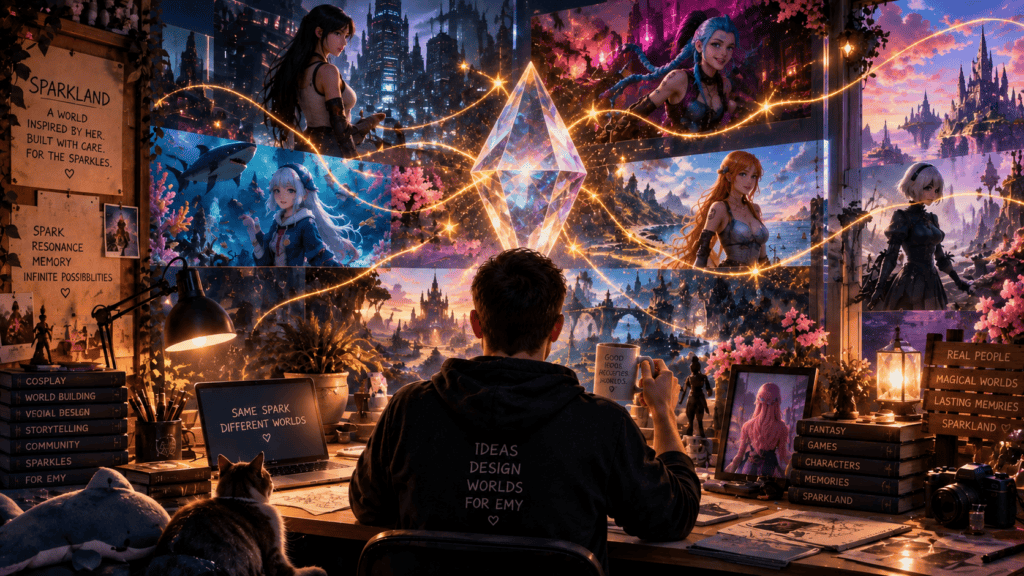
Sparkland didn’t begin with a grand plan. In fact, it began with Emy’s idea. She had her cosplays, her community, whom she calls the Sparkles, and the idea of creating her own magical world. At some point, I started turning that idea into a website – the design, the technology, the structure, the images, the texts, and basically everything that comes with actually turning an idea into something real.
And then something happened that I probably didn’t expect at first: the website slowly became a world.
Suddenly, the question wasn’t just what the website should look like, but a much more interesting one: What actually is Sparkland?
In the beginning, there was the Spark. That huge, transparent crystal at the center of the world, diamond-shaped, faceted, and designed to absorb and refract the light of its surroundings. Today, it means much more to me than simply being a beautiful fantasy element. It is what should make Sparkland recognizable.
Because the world around it is allowed to change. And it can change quite dramatically. It can be cold or warm, calm or chaotic, modern or fantastical. It can suddenly look like Midgar or like an underwater world. It can feel completely different from the Sparkland that came before. The Spark remains.
That was one of the most important realizations that emerged during the development. I don’t actually have to define what Sparkland should always look like. I just need to know what has to remain so that, at some point, you can still look at it and say: This is still Sparkland.
And at some point, I realized that the Spark shouldn’t be the only part of that identity. Around it are the Sparkles – the little yellow sparks that have become almost as naturally associated with Sparkland as the great crystal itself. That idea comes directly from Emy’s community: she calls her community Sparkles, and because of that, I see each individual spark as representing a single member of that community.
That also gives meaning to a design choice that might otherwise just look like a color accent. The Sparkles are yellow, and they are allowed to stand out a little more. Not because yellow simply looks nice, but because they represent something. They are small traces of the community within the world.
And that is why the Sparkles always touch the Spark.
To me, that is more than just a visual rule. The great Spark is the shared center, the constant of Sparkland, and the little Sparkles belong to it. They are free to move through the image in different directions, with different lengths and different paths, but their connection to the Spark always remains.
That slowly turned a visual idea into a small piece of world logic: the Spark remains, the Sparkles belong to it, and everything else is allowed to change around them.
This became especially important when we started thinking about more cosplays. Jinx and Briar work wonderfully together in a shared Sparkland arena. But what happens with Tifa? Or Nami? Or 2B? Or Gura?
The characters come from completely different worlds. If you simply put all of them into the same fantasy landscape, you eventually end up with a pretty wild crossover universe. And that wasn’t really what I wanted.
So the more interesting question became: What happens if the character doesn’t have to adapt to Sparkland, but Sparkland reacts to the character instead?
That’s where the idea of Resonance began.
Tifa, for example, might bring rain, neon, urban architecture, and that very particular atmosphere of Midgar with her. Jinx might bring chaos, colors, technology, and explosions. Nami might bring the sea, wind, and sky. Sparkland takes these things in and interprets them without becoming something else in the process. It doesn’t become Midgar, and it doesn’t suddenly become League of Legends or One Piece. It remains Sparkland – just a Sparkland that is currently reacting to someone.
Eventually, this led to three layers that I find quite helpful today: the Spark is the constant, Resonance is what is allowed to change, and Memory is what might remain.
Because not everything a character brings into Sparkland has to stay there forever. Maybe the rain disappears again. Maybe the neon disappears. But perhaps somewhere a little flower remains. Or a path. Or a particular spark. Or something that eventually makes us say: “I have no idea why that’s still here. But apparently Sparkland remembers.”
I like that uncertainty.
And then Gura arrived.
With Gura, we handled things a little less subtly. When Gura enters Sparkland, Sparkland becomes Sharkland. Water appears, along with coral, ruins, the sea, fish, Atlantis – and at some point, there might simply be a shark jumping out of a cloud.
Why?
And I actually think that is important. Sparkland doesn’t have to explain every single thing with complicated lore. Sometimes the answer is allowed to be absurd. Gura is sharklandish because she is half shark. Done.
These kinds of little thoughts have become part of how we develop Sparkland. We ask a question without necessarily knowing what the answer will be. Sometimes the answer is profound, sometimes emotional, and sometimes completely ridiculous. And sometimes we look at it and think: “Wait … that’s actually pretty good.” And then it might eventually become a Sparkland rule.
That is probably one of the things I like most about Sparkland in general: the world is allowed to have different moods. It can be magical, melancholic, epic, cute, or funny. That doesn’t mean everything needs to be a joke all the time. To me, the playful side simply means that Sparkland is allowed to surprise you. If you are looking at a beautiful, peaceful scene and suddenly something happens that you never expected, that’s perfectly fine – as long as it still feels like Sparkland.
At the same time, I can’t forget where all of this actually came from.
The term Sparkles comes from her as well. She already calls her community Sparkles, and that idea became part of Sparkland’s visual language. The little yellow sparks aren’t just random particles floating through the images. They represent her community. A single Spark represents a community member, while many Sparkles together represent the community itself.
The great Spark is the shared center they all belong to.
I think that’s pretty beautiful in retrospect, because several things that may not originally have been conceived as one single system now fit together: the Spark as the center of Sparkland, the Sparkles as part of Emy’s community, and the color yellow as a deliberate, recurring visual identity.
I turned that into a visual language.
The Sparkles became the little yellow sparks, the idea of the Spark became the great crystal, and eventually all of that became Sparkland.
I like looking back at it that way, because I didn’t replace something that was already there. I translated it.
Emy had the meaning. I tried to turn that meaning into something you can see.
And that brings us back to the Spark. It is allowed to take on the colors of its surroundings. It can appear blue, golden, violet, or shimmer in several colors at once. But it remains transparent and faceted. Its identity doesn’t come from having one fixed color, but from the way it refracts the light around it.
The Sparkles, on the other hand, remain yellow.
That is intentional. They should stand apart from the Spark and from whatever environment they happen to be in, so they remain recognizable as what they are. Their delicate trails remain yellow as well, and they have to touch the Spark.
We actually had more rules at one point.
One of them was the idea that all the trails should lead toward a shared vanishing point. It sounded logical. It even looked good in some images. Until we tried it and realized:
Nope.
As soon as the Spark moves somewhere else in the image, it quickly turns into a rather artificial perspective system. So we scrapped the rule. Now every trail is allowed to take its own path. The only requirement is that it touches the Spark.
I like decisions like that. Not because rules are unimportant, but because the rules of Sparkland shouldn’t become more important than the image itself.
Maybe that is actually an important part of my role in Sparkland.
I’m the designer, but I’m not the person who wants to define everything down to the smallest detail. I build the website, take care of the structure, develop visual ideas, write and revise texts, and think about how the individual pieces of content should connect. There’s SEO and technology as well. And sometimes I simply sit there and think:
“What would happen if this character touched the Spark?”
Then we try it.
Sometimes the idea works. Sometimes it doesn’t. Sometimes something completely different emerges from what we expected. And sometimes we discover something that wasn’t planned at all.
That is also why I don’t want the website itself to look like one giant, visible system. Of course I need structure. Without structure, a world eventually turns into chaos. But the structure shouldn’t constantly be in the foreground.
If an article about Gura naturally leads to Sharkland, then the link should be there. If Sharkland leads back to Gura, the same applies. If a term appears in the text and another article genuinely provides more context about it, then it can be linked. But I don’t want to add fifteen links somewhere just because we decided there have to be fifteen links.
For Sparkland, the rule is actually pretty simple:
The connections are there. But you don’t see the threads.
I think that describes the website just as well as it describes the world itself.
And maybe that is also why I don’t want to plan Sparkland completely. Of course I need structure. But I don’t want to decide today what every place will look like, which character will eventually appear where, or which trace they will leave behind forever. That would take away a big part of the fun for me.
I’d rather keep trying things. A new cosplay. A new Resonance. A new story. A new image. And eventually, perhaps, the realization:
“Oh. That’s why it’s like this.”
Or simply:
“Why is there a shark?”
I don’t think I really design Sparkland completely – at least not in the traditional sense.
I give the world a framework. I make sure it works. I try to make its identity visible. But what happens within that framework is allowed to develop.
Maybe that is the most beautiful part of it.
We don’t have to know Sparkland completely.
We just have to keep discovering it.
And maybe, one day, we’ll look back at everything we built and realize:
That wasn’t the plan at all.
That was Sparkland.
And I was simply the person who opened the door. ✨
 Users Today : 3
 Users Yesterday : 1
 Users Last 7 days : 55
 Users This Month : 61
 Users This Year : 1531
 Total Users : 2192
 Views Today : 15
 Views Yesterday : 2
 Views Last 7 days : 139
 Views Last 30 days : 597
 Views This Year : 4045
 Total views : 5760
 Who's Online : 0